World Cruise vs. Grand Voyage: How to Compare Them
There's no universal industry-wide cutoff that separates a world cruise from a grand voyage. Cruise lines use these labels in different ways, so the name alone won't tell you how far a ship travels or how long you'll be away.
To compare world cruises, start with the itinerary, duration, and daily experience. Once you look past the label, you can judge whether a sailing fits your schedule and the kind of trip you want.
Why the labels don't define a fixed cruise length
"World cruise" usually describes the scope
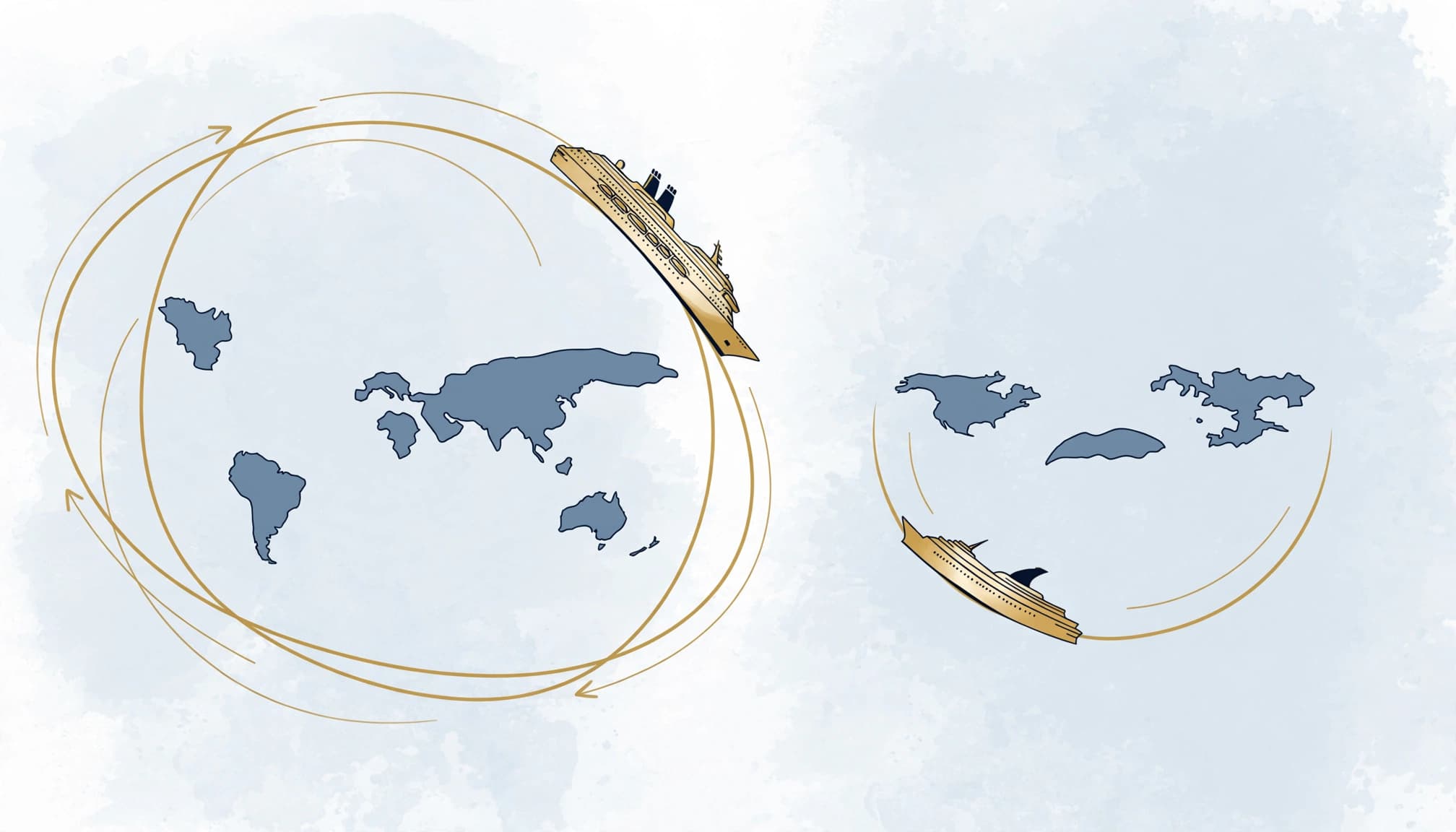
In common usage, a world cruise is a long itinerary built around a broad global route, often crossing multiple oceans and continents. Many last about three to four months, but that's a pattern, not a standard. Published examples include Cunard voyages of 108, 110, and 117 nights, and a 115-day Princess sailing aboard Coral Princess.
A grand voyage generally suggests an extended itinerary, but the phrase doesn't guarantee a specific route or duration either. Holland America Line, for example, calls its 129-day sailing the Grand World Voyage . The title combines both terms, showing why the label can't serve as a strict category.
Cruise line names are marketing choices
One company may use "world cruise" for a full global circuit, while another may apply "grand voyage" to a long regional route or a portion of a longer itinerary. A sailing can also have a branded name that tells you more about the cruise line's presentation than its exact geographic scope.
What published itineraries show about length and route
Long voyages vary widely
The examples span a considerable range. Holland America Line's 2027 Grand World Voyage is scheduled for 129 days, roundtrip from Fort Lauderdale. For 2027, the line also offers a separate 70-day South America and Antarctica voyage. The shorter sailing has a focused regional itinerary, while the 129-day route makes a much longer commitment.
Viking's published options also vary. Its World Voyage III is scheduled for 170 days, while the company lists 142-day and 125-day itineraries as well. The 125-day World Discoveries route travels from Los Angeles to London. These are all extended voyages, but their lengths and endpoints differ substantially. For more detail on the range, see Viking and Oceania's extended world voyages.
The route matters as much as the name
Oceania's published 2026 program included a 180-day voyage from Miami aboard Vista, along with 120-day and 197-day variations. The 2027 program also included a 180-day sailing from Miami. Those examples show that even a single cruise line may offer different lengths under its world-voyage program.
The word "grand" doesn't tell you whether an itinerary circles the globe, travels one region in depth, or links several regions without returning to its starting port. Read the endpoints and port sequence. For example, a roundtrip itinerary and a one-way sailing can require very different flight arrangements at the end.
Compare the experience, not just the headline duration
Look beyond the number of nights
A sailing's total length is a useful first filter, but the number of nights doesn't describe its pace. Compare how many sea days it includes, how long port calls last, and whether the itinerary has overnight stays or late departures. These details affect how much time you have ashore and how the trip feels from week to week.
A long list of ports can still mean brief visits. Overnight calls may allow more time in a destination, while a short daytime stop can limit excursions. Examine the itinerary port by port, especially for places that matter most to you.
Consider the commitment and the complete cost
A full voyage lets you keep the same cabin and onboard routine for months. A segment can offer a shorter commitment, though it may mean joining or leaving the ship mid-route and arranging flights at different ports. The right fit depends on how long you can be away and whether you prefer a continuous trip or a more flexible schedule.
Compare the complete trip cost, not only the cruise fare. Flights, hotels before or after the sailing, excursions, insurance, and onboard spending can change the overall budget. Our guide to planning your first world cruise covers the practical commitment behind a multi-month voyage.
Key takeaways for choosing a sailing
- There's no shared industry rule that defines a world cruise or grand voyage by length.
- A global itinerary, regional focus, departure and arrival ports, and time away matter more than the marketing label.
- Compare port time, sea days, overnights, and full-trip costs alongside the number of nights.
- A shorter segment may suit travelers who want a long-voyage experience without the full commitment.
Frequently asked questions
Is a world cruise always more than 100 days?
No fixed cutoff applies across the industry. Many full world itineraries last around three to four months, but cruise lines publish voyages of different lengths and use names that don't follow a single rule.
Is a grand voyage always shorter or more regional?
No. The phrase has no universal definition, and a cruise line may use it for a long global itinerary. Holland America Line's 129-day Grand World Voyage is one example of a branded voyage that includes "world" in its name.
Can I book only part of a world cruise?
Some cruise lines sell segments of longer itineraries. A segment can reduce the time away, but it may have different embarkation and disembarkation ports than the full sailing. Compare the segment's route and travel arrangements with the complete voyage.
Choose the itinerary that fits your life
The distinction between a world cruise and a grand voyage isn't settled by a universal rule. The clearest comparison comes from the actual route, duration, port schedule, and total commitment.
If you're weighing different formats, Schedule a Consultation to discuss the kind of voyage that suits you. For more cruise-line and itinerary discussions, Subscribe to Our YouTube Channel.
Recent Posts